Sunday, January 28, 2007

Player, dealer...

Macao. It officially came under sovereign Chinese rule in 1999 being handed over by the Portuguese. Almost all the signs in Macao are bilingual: Cantonese and Portuguese. It's peculiar why Portuguese still remains such a part of Macao when it's clear that there are very few Portuguese on the island and it is no longer taught in the schools. Mandarin is now being taught and stressed quite heavily, as was the case in Hong Kong, and subsequently, with the mainland influence now really taking effect, Cantonese has decreased in popularity and significance.

The official currency of Macao is the pataca and it's used exclusively in Macao and only in Macao. The pataca has a 1:1 exchange rate with Hong Kong dollars, and Hong Kong dollars can be used interchangeably througout the island, but the downside is that patacas cannot be used in Hong Kong. The analogy that Ethan and I came up with was that Macao was essentially a big Disneyland where you could buy lots of Disney money that you could use on the rides or to buy cotton candy, but it would only be of value while you were at Disneyland. Once you left Disneyland, or in this case Macao, the Disney money became useless and you would be forced to take a hit in order to exchange it back. After two days in Macao, we ended up having 4000 patacas ($500) left over, and Ethan took it back to the US with him to exchange there. Stupidly, we didn't realize that patacas were so exclusive to Macao, or otherwise we would have used the Hong Kong dollars everywhere.

There's still a lot of colonial architecture that remains and the many areas are reminiscent of the Portuguese-style streets and facades. A lot of the churches in Macao are painted bright colors in a way that immediately reminded me of the multicolored houses of Valparaiso, Chile. Pink, green, and yellow, as in Chile, were all quite common colors.

Macao is the only place in China where gambling is legal, or at least approved by the state. Ethan noted that the casinos in Macao were much quieter compared to those of AC, and I agreed. Though I don't have as much experience as Ethan does when it comes to casinos, it was clear that the people tended to keep to themselves and rarely talked while at the table. I was disappointed that there was no poker in Macao. 24 casinos. No poker. That being said, there was not a big expat contingent as there was in Hong Kong, Shenzhen, or even Guangzhou which would explain why certain Western games wouldn't be played here. Comparatively, Macao seems like a relatively exotic location within China where very few backpackers visit. The rooms are expensive, it's not easy to get to, and nearby Hong Kong is much more of a draw.

Baccarat is an interesting game. It's all the rage in Macao and people wager anything from 100 yuan to 10,000+ a hand. The play begins with a betting round in which you can bet on the dealer, the player, or a tie. You get dealt two cards and the goal is to get closer to nine. The closer your two card total is to nine, the stronger your hand. Let's say you bet 100 yuan on the player. The dealer then deals you two cards and two cards for himself. You win if you beat the dealer's hand. When the hand is over and the winner has been determined, the dealer flips over a chip that says "Player wins" or "Dealer wins".

It sounds simple, but Ethan and I were unable to figure out how to play exactly because we didn't know the value of each card. It didn't stop us from playing though and as a result, the real excitement came from trying to guess which chip the dealer was going to flip over as we couldn't understand what each card was worth. I think Ethan finished up about 1,000 yuan playing a game that neither of us really knew the rules to.

The most fun part of Macao was the greyhound racing park. I had never seen a greyhound, let alone a greyhound racing park. I remember a long time ago when I used to listen to Opie and Anthony when they talked about visiting a greyhound track. They would tip some guy to go to the paddock area and watch which dog took a dump last because it was always the fastest one. I explained the strategy to Ethan who like myself had absolutely no clue how to handicap dog races in China, so we began watching the last one to take a dump. We didn't have to tip anyone because they brought the dogs out and paraded them on the dirt before the race. Each time we would bet on the dog who shat last. We were picking winners, placers, exacta boxes, you name it. I think we finished up about 150 yuan, which was a lot considering we were betting 10 yuan a ticket.

Interestingly, the dog track seemed to attract the same sort of clientèle that a horse racing track would attract in the US: single middle-aged balding men. There might have been one woman in the whole place. We were the only foreigners. I might have been the youngest one there.

The race itself was anti-climactic to say the least. After the dogs are paraded around, they're placed into a big metal box. After they're locked in, all the dogs start barking and scratching and howling and the metal box starts to shake. When the door opens a small stuffed animal swings by on the inside of the track and the dogs bolt out. The race was incredibly difficult to follow because there was no camera that would follow the action and the whole race was literally over in about ten seconds. Like with playing baccarat, the excitement really came at the end seeing who won after all the action was over, and not with the actual event itself.

Before visiting the dog track, Ethan and I went to check out a Jai Alai stadium but unfortunately, it had been torn down a few years ago. I would have guessed it was demolished because the city wanted to make room for more commercial or residential development in the expensive downtown area. Ethan remarked that a similar fate probably awaited the dog park. This huge open space in downtown Macao was surrounded by enormous skyscrapers. It's hard to believe that in ten years, the track will still be there serving this handful of single middle-aged men while Macao develops and expands at such a rapid pace.

We hit up some more casinos looking unsuccessfully for a 10 yuan minimum blackjack table and then took the ferry to Hong Kong.

we said Beijing duck, not Shenzhen duck

Shenzhen was the first stop on Ethan and my trip around China (after Nanchong). After flying to Guangzhou, the capital of Guangdong province in the southeast of China, we took an hour train to Shenzhen. The city was once a miniscule farming town of 45,000 before it was given SEZ status and turned into a pocket of unbridled capitalistic development. The first day there we hit the big shopping downtown area where Ethan picked up a pair of shoes and I unfortunately couldn't find anything I liked.

Shenzhen was a memorable experience, not because of anything specifically noteworthy about the city itself, but because of the number of times we were scammed. The first was when the two of us stopped in to get some Beijing roast duck for lunch. For those who don't know what Beijing duck is, it's roast duck served with a soft tortilla like patty, plum sauce, and cucumber or chives. You take the pieces of duck dip it in a little sauce and roll it up in the patty and eat it with your hands. I should preface this by saying, Ethan and I both love Beijing duck with an unquenchable passion and can consider ourselves connoisseurs given our extensive experience. So before entering this restaurant I asked the hostess who stood at the front entrance whether or not they had Beijing duck (Beijing kaoya) to which she replied yes, of course. Ethan and I sat down and ordered the duck and waited a few minutes for it to be prepared. First our waiter brought out the pancakes along with the plum sauce and chives. A few minutes later the duck arrived.

I started to prepare my first patty by spreading a line of plum sauce and reaching for a piece of duck. I remarked that there was an inordinate amount of duck skin and not much meat. Ethan then looked at the plate of duck and remarked that not only was there a lot of skin, but the plate of duck was just skin and contained no meat at all. The plate of duck appeared to have an ample amount of skin and meat, but in reality, there were only about ten slabs of dry skin propped up underneath by some puffy wafers of some sort. We were paying 48 yuan for ten pieces of duck skin and some chips.

Ethan called over the waitress and we began to argue that this was not what we had ordered. I explained that we wanted Beijing duck. It sort of went like this:
Me: "What is this? We ordered Beijing duck."
Watiress: "This is Shenzhen duck."
Me: "Where is the meat?"
Watiress: "What meat?"
Me: "We ordered Beijing duck, you didn't give us Beijing duck."
Waitress: "They are the same thing."
Me (pointing to the picture in the menu): "This is what we ordered. Beijing duck. You gave us the duck skin, not Beijing duck. We want Beijing duck."
Waitress (calling over manager): "This is Shenzhen duck."
Manager: "This is Shenzhen duck."
Me: "We want the meat. Where is the meat?"
Manager (signals to a waitress who brings over a skinned duck): "You want this?"
Me: "We want the meat, yes."
Manager: "We don't serve the meat. This is Shenzhen duck."
Me: "I asked you if you had Beijing duck and you said you did. This is not Beijing duck."
Manager: "Do you want to eat this?"
Me: "We want the meat."
Manager: "Shenzhen duck doesn't have meat."
Me: "Forget it."

So Ethan and I got up and left. They were fine with letting us leave without paying, even though there was food served to us, and I had eaten a few of the wafers propping up the duck skin. We concluded it had to be a scam (unless anyone has heard/knows anything differently, in which case let me know) because I can't think of anyone who would pay 48 kuai for ten slivers of skin.

The next scam took place when I was at a grocery store looking for some candy that Ethan wanted. Near the check out a woman was tending a small kiosk that sold China Mobile phone recharge cards that you could use to put money on your phone. I purchased a 30 yuan recharge and asked the woman to put it for me. Big mistake. She did it and immediately after I tried to call Ethan but it said I was still out of funds. I asked the woman why it still didn't work. She said I had to wait 30 minutes. So I waited 30 minutes. Then I waited an hour. A day. Three days later I still had no money and the phone recharge code no longer worked.

Before leaving Shenzhen to Macau, Ethan and I checked out the big computer center located near the clothing area downtown. I think Ethan needed some USB memory or something and I was looking for some camera memory also, so we stopped in and looked around. One of the shopkeepers told us they have 1 GB, 2 GB, 4 GB, and 32 GB USB drives. I was flabbergasted. 32 GB on a little tiny pen drive? Impossible. Or maybe not. Clearly not having learned any lesson before I asked the price on the 32 GB, which was 250 yuan. I asked to try it in a computer and the shopkeeper connected it and showed that it indeed had a total space of 32 GB. Something had to be up. It had to. No way this little thing could have 32 GB of space on it. Ethan transferred some files onto the drive and sure enough it now read 31.7 GB.

We bought two for 400 kuai and while I continued to look at camera memory, Ethan went over to another shop. He then shouted to me that they had 64 GB pen drives also! D'oh! At some point Ethan handed his newly purchased 32 GB over to the other shopkeeper and explained to Ethan that it was falsely reporting the 32 GB space using some program to mask the size. The other shopkeeper removed the program and showed us that really it only had 512 MB. By the time Ethan had come back to warn me, I had purchased a 4 GB camera memory which also turned out to be masking it's size. We demanded our money back and fortunately without having to shout, punch, or break things, the shopkeeper returned the money. Ethan says that we should have gone to the other shopkeeper who warned us of the scam in the first place to buy something as a reward for alerting us to the ripoff, but we had to catch the ferry to Macao and were already very late.

Leaving Shenzhen that night was a relief. It was really overwhelming being there. It seemed everyone was out to get our money in some way. I did manage to pick up all six seasons of Oz though, and surprisingly each CD works perfectly. Off to Macao...

fotos de mi gato!

la jefa de una tienda alrededor de mi departamento me dio un gatito hace unos meses porque iba a abondanarlo/dejarlo en la calle. en esa epoca buscaba un gato y cuando la jefa me conto eso, tuve que llevarlo.

aqui son algunas fotos de mi gatito que se llama 'Xiao Qiang'. mis estudiantes le dieron el nombre y creo que proviene de una pelicula china muy conocida pero se me olvido como se llama. significa 'un poco fuerte'. a Xiao Qiang le gusta morderme con tanta frecuencia y ha llegado a molestarme bastante. a la vez es bien fuerte tambien. lo estoy tratando de enseñar por tirarle con agua y gritar cuando me ataque pero ya no ha mejorado. espero que cuando sea un gato adulto, no esta tan loco. bueno, al fin es un gatito precioso. siempre duerme en mi cama y me sigue cuando camino por mi departamento. lo echo de menos cuando no estoy en casa. a ver... las fotos!


Wednesday, January 24, 2007

Too much to write now

After the 9 day break from Nanchong, it's a smack in the face of what a different world this small city is, for most accounts, drastically ideologically contrasting when compared with the rest of China.

Xi'an: la 2da parte

Deja que las fotos hablen por si solas...


<- Singing happy birthday to my mom with a group of Chinese computer science students we met on the street. You can see the whole video at: http://www.youtube.com/v/Li9P7BxBhQA.


<- Terracotta warriors. Needs no explanation.


<- X mas celebration in downtown Xi'an. There must have been over 50,000 people in the streets. Roads were blocked off and everywhere people were setting off loud firecrackers that would sometimes go off just several feet from you.


<- Bell tower in downtown Xi'an where my brother and I paid ten yuan to ring the gong six times and celebrate our mom's birthday again. View the video: http://www.youtube.com/watch?v=Z9Rjs9SoUeI

Tuesday, January 16, 2007

to guangzhou tomorrow

In Hong Kong now. Too much to say. Really an enormous and overwhelming city. It'll be nice to get back to the mainland tomorrow.

Tuesday, December 26, 2006

chestnuts roasting by an open fire : part one

And by chestnuts, I mean sweet and sour pork, and by open fire, I mean a greasy wok. Anyway, I went to Xi'an this weekend to meet up with a few other PCVs from various other Peace Corps sites. My brother recently arrived in Beijing and after telling him I was going to Xi'an, he and I decided to meet up the following morning.

I met him at 8:30 at the train station in Xi'an after one of the longest and most uncomfortable train rides I've ever experienced. Trains from Nanchong don't go directly to Xi'an, so I had to transfer in Dazhou, a smaller city about three hours east of here. It was actually very interesting. When I went to go buy the ticket in Nanchong, a man tried to cut in front of me and buy his ticket first at which point the cashier explained something to the man in Chinese, and the man recoiled and went behind me. I couldn't pick up everything the cashier said as the local dialect is enormously different from standard Mandarin, but I could understand it was a scolding of some kind and she was explaining that Chinese people shouldn't act that way. The big stereotype of Chinese train stations is that it's first-come-first-served, and pushing and shoving is not only acceptable but encouraged. This clearly evidences, however, that it's changing and it felt really good to know that someone was on my side trying to help the poor laowai get his train ticket. So, with my ticket now, I left at 4:00 to Dazhou.

After arriving in Dazhou at 7:00, I had three hours until the train to Xi'an. Unfortunately, the train from Dazhou to Xi'an was considerably longer than the train from Nanchong to Dazhou; around ten hours. I should probably mention there are three types of train tickets in China:
-Yingzuo (hard seat: the most basic ticket. Essentially a bench with a thin piece of padding with a cloth cover. It's not bad for short trips, but it hurts after a while and it's nearly impossible to get any sleep unless you're by the window where you can put your head down on the table or next to the window)
-Yingwo (hard sleeper: six beds in an open compartment. 66 beds (I believe) in each car)
-Ranwo (soft sleeper: four beds in a closed compartment. I can't remember off hand how many in each car)
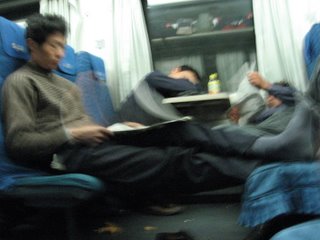
So, I have an yingzuo on the ten hour ride from Dazhou to Xi'an and the biggest problem with the yingzuo is that you have very little leg room. You can't stretch out in front of you because there's another passenger. You can't put your legs into the aisle because there are food carts and cleaning personnel that come down the aisle and have no qualms about stepping on your feet or nudging you to wake up and move. I'm also seated in the aisle seat so falling asleep is much more difficult because there's no armrest and no place to really support your head. I admit I have pretty bad posture so naturally I want just to lean back and prop my head up somewhere to fall asleep. No such luck. Imagine trying to fall asleep on a ten-foot-tall stool, and you have some vague notion of what it's like at 3:42 AM on an yingzuo from Dazhou to Xi'an.

At around 4:00 I got up and walked from one side of the train to the other and managed to scout out a few seats where there was no one sitting in or on the either side of the seat. This meant I could put my head down on the mini table or up against the window and stretch my legs out. It was divine. I managed to get an hour or so of sleep before a group of really loud and screechy women came and began chatting until we arrived.

Once in Xi'an I called my brother and he was still on the train from Beijing. It was about 7:30 and he would arrive in an hour or so. I walked around the train station for a while, bought some bananas and cookies and then returned to the station where I met him.

Stay tuned for part two.

Last thing: there was almost a fight in one of my classes today between two of my male students. It was in my advanced oral English class where I'm having my final examinations in which groups of seven or eight students which have respectively researched topics of the Iraq war, gay marriage, or immigration will use the formal debate structure (opening statement, cross examination, rebuttal etc..) to argue against each other (more about this later). Anyway it was at the end of class and I'm not sure what was said, but one student slammed his water bottle down on his desk and jumped up at which point the two students were face-to-face separated by only a few inches. The rest of the students who were packing up their bags immediately turned and the whole class fell silent. It was scary in that "I hope to god this doesn't happen but it sure looks like it will" sort of way. They looked like mountain goats eying each other out before butting heads. Fortunately, one of them turned away and left before the situation escalated, but I really thought I was going to have to break up a fight. When I went to eat hot pot after class with some other students, they didn't hear what was said, but the two guys involved apparently have a long history of confrontation and both have notoriously short tempers. I'll see if I can more information on what exactly happened later.

Saturday, December 09, 2006

The GAP catalogue


The new fall line is in. Here's Bill in a delightful sweater vest ensemble available in cream (shown here), burnt umber, and navy blue. Perfect for barbecues, picnics, or back-breaking manual labor: $40.

Friday, December 08, 2006

short about the lecture

I was asked a couple weeks ago to give a lecture at the school by Kitty, the head of the English student union organization. There weren't any details about the content except that it should be around 90 minutes and about whatever I wanted. In my classes I incorporate some lecture, but for the most part, there's a lot of discussion and interaction. I thought about how I could talk constantly about something for 90 minutes and make it interesting at the same time and realized it required a lot of planning.

The lecture was scheduled for 7:00 PM this night, and in typical Phil fashion, I started working at 4:30. I had told Kitty the topic would be culture, but in order to give myself some leeway so I could change the content in the future if I wanted to, I didn't tell her much of the specifics about what exactly about culture I would be talking about. I wasn't worried though. I wasn't going to be reviewed in any way and I knew that even without any planning I easily make a 90 minute speech about culture.

I figured it should be a lecture about something students were curious about. I haven't seen a Chinese teacher's lecture, but according to other students, all of the lectures from Chinese teachers are pretty dull. It's essentially a professor at a podium speaking for 90 minutes. It was a Friday night and I know I wouldn't want to attend a lecture held by a foreign teacher about something strictly academic, so I decided it I would try to keep it light. The biggest thing was making sure I didn't stand and talk like the Chinese teachers, but I love to be dynamic when I'm on stage so that was the least of my worries.

Knowing students absolutely love to look at pictures and are incredibly curious about traveling and foreign culture, I took about 45 of my nearly 2,500 travel pictures on my computer into a powerpoint separated by information slides about culture:


-Culture is what makes us different
-Culture makes our cities different
-Culture is our ideas about religion
-Culture is what gives us ideas about what is acceptable and unacceptable, what is good and bad, and what is funny and not funny
-Culture is the food we eat
-Culture is what we like
-Culture is also what we don't like
-Culture makes us friendly

After each slide I put in some pictures from my travels. I explained the pictures and told some stories surrounding them. The time when I got my cell phone stolen with a friend while sneaking back into estadio nacional after leaving to buy pisco got the best response. I used some pictures of dishes from Chile and Egypt for 'the food we eat' and the pictures of the protests in Chile for 'what we don't like'. Man, I love those protests.

I ended with a slide about what I have learned from traveling:
What have I learned?
-Culture is a beautiful thing
-We are all different, and culture is what makes us different
-You cannot get rid of your culture
-We need to respect other cultures

The whole thing went flawlessly. I couldn't have asked for a better response. After my speech, which lasted about 60 minutes, I opened it up for questions, of which there were a number and I had to end the Q&A session myself after about 20 minutes to prevent it from dragging on. There were lots of laughs (exactly what I wanted), and afterwards lots of people came up, asked to take a picture, and thanked me. I then took some of my students who had come to the lecture out to eat some hot pot and a local restaurant.

I also heard one of the English teachers, described by Kitty as 'plump', is interested in my new online newspaper for students: www.cwnutimes.com. I'm not sure in what capacity, but it'd be nice to have a Chinese English teacher around to help or maybe write some articles. I've put a lot of time into the website so I hope it's successful. The first meeting is on the 13th, and I've been actively promoting it by telling other teachers and students to put up flyers and inform their classes. I have absolutely no idea how many people will show up on Wednesday.

In all:
a great day.

Thursday, November 30, 2006

newspaper + education

So this online newspaper I have seems like it's really coming together. I've come up with an advertisement and scheduled a first meeting for December 13th. I've made an announcement in all of my classes and it seems like a great deal of my students are really interested. The biggest challenge I see now is making sure that the content isn't vapid and trite articles about, 'How great my hometown is'. I'm not too worried about the sophomores and juniors. I'm really worried about the freshmen and non-English majors whose English is considerably worse but arguably exhibit much more confidence than the English majors.

I'm not sure why the freshmen and non-English majors have more confidence when speaking than my sophomore and junior students. The freshmen are the only ones who will come up to me in the hallway and ask me questions, even though they're just the dull milk-toast questions about whether I like China. I'm not even sure what happens that makes students shy about approaching a foreigner in the first place. I know when I had native Spanish speakers at F&M I wasn't necessarily afraid of approaching him or her. I never went up to one and initiated a conversation like some of the students here do, but I think it would just be strange to walk up to a professor and ask her if she likes American food.

In any event, I was never shy about approaching a professor. I think a lot of the apprehension here has to do with the level of the professor verses that of a student. The word for teacher, laoshi, literally means old master and the laoshi in China is certainly considered more knowledgable and therefore above a student. In the US, the tradition is for students to actively question as opposed to passively receive, which would explain the emphasis on participation and volunteering in American classrooms. I believe that is the biggest difference between American and Chinese classrooms. I've seen a couple classes here and for the most part, there is little teacher-student interaction. Most of the information is one way only. It's been difficult to get students to consistently participate, but the progress that I've seen so far, although not the level I'd like it yet, is quite surprising and commendable given the students' educational background up until now.

Perhaps it's unfair to compare the F&M liberal arts education to CWNU though. I think most unviersities in the United States are not like F&M, and are probably just as impersonal in terms of professor-student relationships as I think CWNU is. I don't have much experience with big schools, so I should say that these conclusions are somewhat unsubstantiated considering. Students here though have very little face time with professors, and interaction between students and professor is fairly limited. I do everything I can to make sure I am available to students at all times: I have office hours, give out my e-mail and phone number, hold review sessions, visit English corners etc... but I am the only English teacher that does this. Chinese professors, at least the ones I've met so far, don't hold office hours and never visit English corner. There is a bi-weekly showing of an English movie by Mr. Hao, but the word 'showing' is a misleading term. I thought originally that Mr. Hao would explain the context of the movie and give some background, but it turns out all he does is choose the movie and give it to a student to show. That's certainly a better situation than having no movie at all, but it lacks the personalism that I've experienced throughout my schooling. I've inquired about showing my own movies (which I now have quite a collection of) but students seem content with having Mr. Hao choose the films for them.

In any event, this newspaper shows some promise for bridging the professor-student gap even more, and making sure that students have another English outlet. More to follow...

Tuesday, November 28, 2006

The vet

So I went to the veterinarian yesterday with my cat to investigate the scabbiness and flaky skin problems it was having. When I got him out of the box, the vet instructed me to hold the cat's neck between my hands while he gave him an injection. While giving the injection into the back of his neck, the little cat squirmed away and I can only imagine what sort of pain he experienced wiggling with a needle in his spine.

The vet gave another injection to the cat and placed him back into the box. At this point the cat became limp and unable to walk. I asked if he was okay, and the vet responded that, no, in fact he wasn't ok. A few minutes later, and the kitten was completely comatose. There was no movement at all in his limbs. He wasn't even blinking. The vet then left the office and took me and the cat in his carry box (actually just a cardboard box from my parents with a soft sheet) to his other office (across the street) where he told me to sit and wait. The vet then left me and the cat and returned to the main office.

Ten minutes passed and nothing happened. The cat was just as limp as before. The vet returned and held up the cat at which point the cat's head snapped back. He put the cat back into his box and he lied there motionless again. At this point I began to look around this office and noticed an empty bottle of baijiu (rice alcohol) and a couple half-drunk beers on a table in the center of the room. The vet then gave the cat another injection with no reaction and then took a sip of beer. When I finally got a smell of his breath, I could tell he was drunk, and not just any drunk, this guy was clearly under the influence. I probably wouldn't have minded if it were my doctor. I think it would be humorous to see my doctor drunk and trying to assist patients, but here was this veterinarian trying (at this point) to rescue a cat that he had hurt with his negligence. This picture here is of the doctor's table where the bottle of baijiu, which is now in the trash, was previously lying on the ground.

The vet left again and returned with another injection. No reaction. He told me to wait again and I sat there while he left to his other office. He came back again with another injection. Nothing. At this point it went through my head exactly what I would do if the cat died there. Did I have any recourse? It turns out he is also a teacher at CWNU, but doubt there is anything I could do other than try my best to express my anger in Chinese.

Finally after an hour and a half of sitting and staring at the lifeless cat, he began to come to and began to move his legs. Eventually he was able to drunkenly move around with great difficulty. Only this morning was he able to walk in a straight path. I've asked about other vets in the Nanchong area.

Today I continued talking about debating in my advanced oral English class. I'm leading up to a big debate as a final exam in which six groups will individually debate the pros and cons of the Iraq war, gay marriage, and immigration reform. I'm slowly taking them through each part of a debate; the opening statement, cross-examination, rebuttal, and closing statement. Each week we talk about a new topic and practice another aspect of the debate structure.

Today's topic, perhaps partly for my own interest to see their ideas and to give them some more background into contemporary American politics, was the legalization of marijuana. Not one student of all 150 students I had today was pro-legalization. Everyone had these weird notions of what marijuana did and what the effects were. Some ideas were very extreme, that marijuana could cause the breakdown of society: smoking or touching marijuana would make the person violently and deliorously addicted, ultimately leading to disorder and chaos. Other students were tamer and only talked about the harmful effects of smoking on the lungs.

I asked where they got this information, and most of the students responded that it was from CCTV (the Chinese national television station). I wish I could see some of the commercials that talked about drug use. I can ony imagine that it was like those 1930 films about marijuana called 'Reefer Madness'. On the bus from Nanchong to Chengdu a propaganda short about birth control was intermittently shown during a movie on the bus's tv screens. The short began with a number of sperm swimming incessantly through a beige-ish background. The camera then focuses on a single sperm that begins to take on certain animal-like qualities. It stops swimming and looks around like a worm would coming out of a hole. At this point the image faded away and a message popped up in English and Chinese: 'Don't leave anything to chance'. I must have watched the little lonely sperm movie at least ten or eleven times by the time the two hour bus ride was over.

Only a few of them mentioned it was their parents who had told them marijuana was bad. I made sure to explain that what made a drug 'bad' was relative and explained that coffee, cigarrettes, and beer all are techincally drugs. After going deeper into the pros and cons and having the students practice cross-examinations, it seemed that the ideas of marijuana-induced destruction and chaos had faded away.

It's raining and my food is getting cold. Back home now...

Saturday, November 25, 2006

MERRY THANKSGIVING DAY, Phil!

One of the text messages a student sent me on Thursday. It's interesting the way American holidays, regardless of their significance, are observed/celebrated here in China. Students have absolutely no idea what Thanksgiving actually is, but they sent me many messages and believe it is a time to celebrate. Thanksgiving and Christmas are the two most widely observed American holidays here by far. Easter is probably third. I consistently have to explain that Thanksgiving is an American (cultural) holiday while Christmas and Easter are religious ones.

When I say that I don't celebrate Christmas, all of my students gasp in wonderment. An American who doesn't celebrate Christmas? Then I have to explain what Christianity is and why I'm not Christian and why I also don't celebrate Easter. I'm sure these holidays are relevant in China only because the Chinese understand that they are significant in the US. A lot of my students related Thanksgiving to the Chinese mid-Autumn moon festival; a time when you get together with friends and family, but they had no idea as to what Thanksgiving was really about; historically and culturally, at least.
On Wednesday, the day before Thanksgiving, I went with some other foreigners to eat huoguo, Chinese hotpot; essentially a simmering bowl of hot oil in which you cook various dishes in before eating. I hear hot pot is more popular in Sichuan province than it is in some of the other areas, which may be because of the Sichuan propensity to spicy foods. It was as close to a Thanksgiving dinner as one could actually get in Nanchong.

In my writing class last week, I taught about how to write thesis statements. As an example, I had students come up with a list of facts about a topic, come up with a few thesis statements about the topic, and then underline the facts that support that statement. As a demonstration, the class made facts about the school dining hall which is apparently a den of rank and inedible filth that no one likes. Everyone was negative about the dining hall, and supplied facts like, "The food quality is poor", "The service is slow", and "The chopsticks smell bad". Then one of my students said that, "The peanuts taste good", and I thought it was one of the funniest things I've ever heard. I've started using it to describe other situations in the way that you might use the phrase, "Well at least you have your health". For example, my apartment is cold, the floor is dirty, and I need to take the trash out.. But at least the peanuts are good".

After waiting several weeks and many trips to the old campus, I've also finally got my saxophone from home. I'm not sure where it was during the week in which I know it arrived and the time I picked it up, but at least it is here and with me. I inquired at the music department about finding some other people, a bass player or a piano player, to help make a little jazz group. Chu Longfei, a very nice guy and a saxophone student at the school, said he knew some people and would ask around. It sounds promising.

Last Friday I went to Chengdu to buy a new camera and visit Pierce, another PCV who was in Chengdu for some health exams after being injured in an altercation coming out of a bar at his site in Lanzhou, Gansu province. It was good to see him and we and another PCV Matt went to a Western restaurant called "Pete's". Nothing like a break from Chinese cuisine. I got a Reuben sandwich and Key Lime pie. So good.

I took the bus down to Chengdu in the morning, but because the busses stop at around 6:30, I was forced to take the 9:30 train back which takes another hour. The train has assigned seats and when I went to my seat, I found it was taken by a Chinese construction worker talking with his friends. I found a seat nearby as to not disturb the man, but eventually someone told me I was in his seat and I had to move. I apprehensively went up to my real seat and showed the worker my ticket. He apologized and I sat there uncomfortably for a few minutes until I whipped out the pack of cards I had in my pocket and asked the workers if they wanted how to play "Dou Di Zhu" a game similar to "Asshole". It literally means "Kill the landlord" and everyone knows how to play it here. People usually play for money (about five kuai a hand), but I am reluctant to ever do that. Everyone crowded around to see the laowai playing cards. It was a great time. I asked them some questions and then took a nap. I woke up to find everyone else around me also passed out. It was the first time being on a Chinese train, but certainly not the last.


Wednesday, November 15, 2006

..aaaand we're back

So I've neglected to update not because I didn't have anything to post about, but because I haven't been able to log into blogspot for a long time now. Chinese internet is often unreliable and sometimes sites that are accessible one day, may not be the next. The free university internet in my house also went down a couple weeks ago and has only come back just now. Did I mention I have free high speed internet in my apartment? Another PCV coined the term Peace Corps: Cadillac program. True. It's definitely a different experience than being in Africa and several days away from a computer (no names).

Anyway, the Halloween party I had at my house was a success, and people ended up dancing and having a great time. I'll upload some pictures in a bit. Other news will also come soon.

Saturday, October 28, 2006

a little about the campus

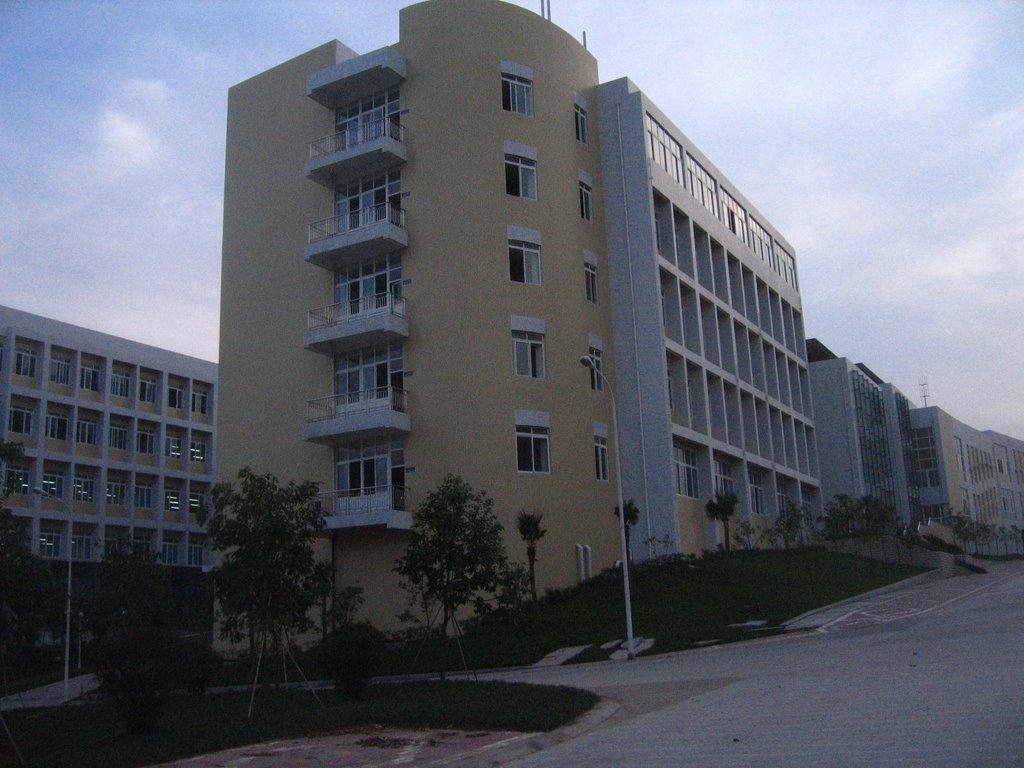
There are two campuses to CWNU. The old campus, located right in downtown Nanchong, is where the science classes and all of the department offices are. The new campus, which is on the outskirts of town about 25 minutes by bus, is where the foreign language, mathematics, post graduate students, and one American English teacher live. (This picture is of the first foreign language building. There are two nearly identical ones towards the left of this one).

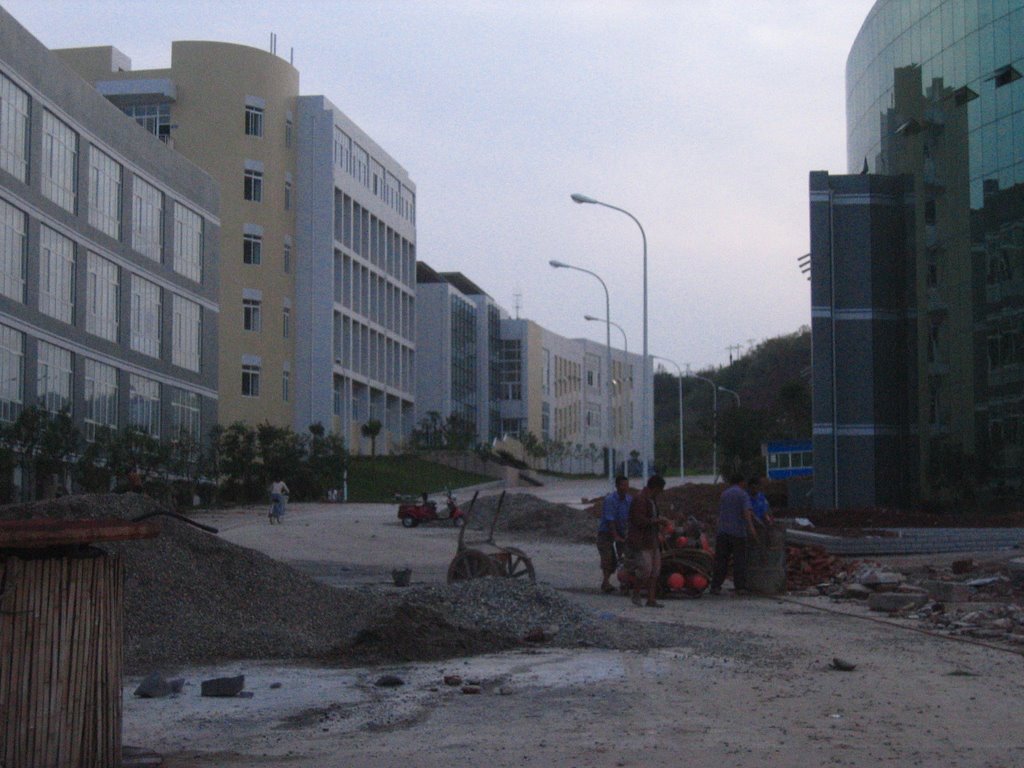
The new campus is still under heavy construction. Most of the buildings are completed, but the finishing touches are still being put on. Trees are being planted, streets are being paved, and plaques that I can’t read are being put in place. The construction never really seems to stop either. Behind my apartment complex, the school is building new teacher's apartments when the new campus is opened to the rest of the faculty. During the week, there are cranes and jackhammers until about 1:00 in the morning. The crews start work at around 7:00. The workers live in little makeshift huts next to the construction site. When they're not working, the construction workers dress surprisingly formally. Most workers wear grey but stylish blazers and coats, collared shirts, and slacks.

The classrooms here are fairly basic, but clean and have good acoustics. The rooms are set up with rows of three seats on the left, five seats in the middle and another row of three seats on the right side. I have access to a computer lab for my Advanced Oral English classes, though I find having computers can sometimes be a distraction. In the computer lab, there are two rows of four connected desks each containing a computer monitor, keyboard, and mouse. Chinese students have this tendency to look down and away from you when a question is asked to the class, especially if they don't know the answer. Adding a computer screen only gives the students another reason not to look up at me. In the front of the classroom is a teacher's computer where I can control what is put up on the screens of the other computers in the class. Unless I absolutely need to show something relevant, I will use one of the regular classrooms because the desks in the computer classroom are small and it's more difficult to split students into groups.

Some of the department offices will be moved to the new campus next year, as well as some of the teachers’ residences. (In the picture: a new science building on the right not yet in use and some construction). It’s nice being the token foreigner on the new campus though. People never seem to get used to seeing me around. Even at campus restaurants that I regularly frequent, I am always greeted with smiles and a big Chinese “hallo!” There is one woman who always is ecstatic to see me. She is by far the nicest person I have met in China. She runs a small campus store that sells fruit, drinks, household items, toiletries, and various non-perishable foods like dried noodles. The store is near my house and I drop by during the week after class to get a water or some chips. When I leave she always tells me, “Zuo yixia!” (Please sit!). I rarely do because I’m tired after class and I’d like to get home. When I say that I don’t have time or I’m tired, she offers to have one of her friends drive me home on his motorcycle.

I feel that hospitality like that is a real crap shoot. There are a few reactions that a foreigner can expect here. I think the most common are shyness, bewilderment, fear, and just plain apathy. I try to make as much communication as I can without seeming overly aggressive. If I can tell someone is talking about me I acknowledge them with a smile and a “Ni hao”. No one expects a foreigner can speak Zhongwen, so I think most Chinese are reluctant to approach a foreigner especially if they can’t speak any English.

At the English corner yesterday, the topic was sports. It officially begins at 8:00, but I have class until 8:30 so I got there half an hour late. Like last time, I took one step outside and immediately a crowd of Chinese freshmen immediately circled around me. It reminded me of the ponds here with the millions of enormous goldfish that swarm together when you drop a few flakes into the water. It was unfortunately a lot of the same questions. “HEY! Excuse me, SIR!! Do you like China?” and “Excuse me! What is the difference between Chinese and American universities?” Most students associate me with the rest of foreign teachers, but being with the Peace Corps separates me in terms of my goals and role at the school. I’m a volunteer and I’m interested in development, and not money, religion, or marriage (I know people that are here for each).

Next week I am hosting a Halloween party at my enormous house. I’ve invited a few of my classes to attend. I’ll be dressing up as a Chinese security guard with some clothes I bought at a local store. The hat, tie, shirt, patches, and tie clip combo was 60 kuai and I haggled it down to 50 ($6.25). I’ll have to explain the concept of an American party to make sure that students know it won’t be a banquet and you don’t have to arrive on time or stay for the entire time. The party is costume-mandatory, and there’s a prize for the best costume, so I’ll be taking lots of pictures.

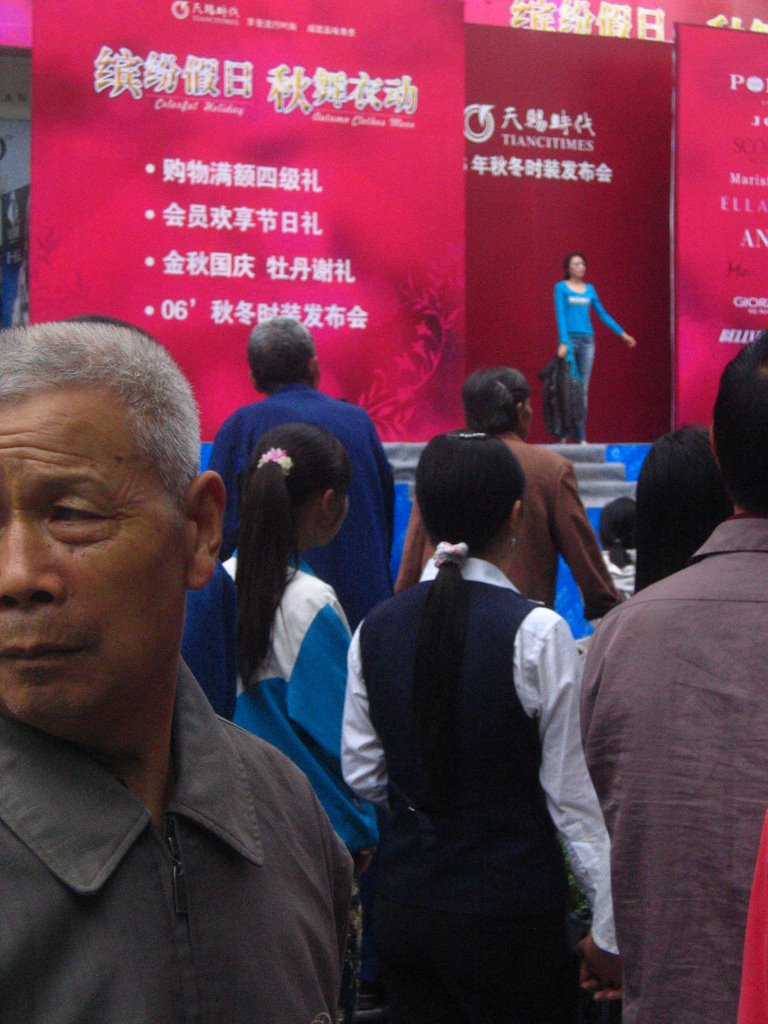
This last picture is from a fashion show at a fancy mall in downtown Nanchong. Public activity here tends to attract crowds of onlookers whether or not you're included in the intended audience.

Thursday, October 19, 2006

losing face

Today was my first real experience with losing face. I feel bad for the girl because I know it was my fault, but my own cultural background told me it was ok. In retrospect I shouldn't have done it, at least not so vocally.

In my writing classes, I always begin class with a 10 minute writing warm up that I collect after time is up. After the warm up, I have a grammar touch-up exercise that includes correcting a short passage or a number of sentences. The goal is to fix some basic stylistic or grammatical mistakes that I can see most of the students make in their writing. The topic for the writing warm up today was "Whom do you admire the most, and why?" Looking at some of the papers while the students were writing, I glanced at Bella's composition entitled "A Angel". When time was up, I asked my monitor to collect all of the essays except Bella's. Coincidentally, the grammar touch-up exercise was when to use "a/an" and "the" (indefinite and definite articles).

Bella didn't take this the right way though. I had intended to show here why it was wrong and allow her to correct it, but when I asked her to hand her paper to me to show the error, she put her head down on her desk and refused to look at me. I froze for a second and then continued with the grammar correction. When I looked back at Bella again, I could see her face was flushed and her eyes were glassy as if she had been crying. After the grammar touch-up I went over a few phrases and idioms: "If wishes were horses then beggars would ride" and "Luck favors the well-prepared". I called a break early in order to leave enough time to go over the story book assignment due next week.

During the break, a student came up to ask me a question about the "beggars would ride" phrase, and out of the corner of my eye I saw Bella ripping her composition up into little pieces. I acted as if I didn't see it. After class ended I called Bella over and spoke to her privately. She had visibly calmed down and apologized numerous times for destroying her paper. I explained that I didn't single her out because her essay was bad, but because I wanted her to correct the gleaming mistake in her title: "A Angel". I also apologized and told her to bring me a new copy the following week. Phew.

After class a couple students, Tovell (from my advanced oral English class) and Jane, winner of the CCTV cup English competition, met me at my classroom and asked me to come to the English corner. I congratulated her again for winning the Xi Hua competition and asked her when the next round would be. It turned out the Sichuan Province-wide finals were last week, and, according to Jane, the winner was, "a very nice boy from a university that I can't translate into English. Electric something..." Thanks, Jane.

I was surprised to see so many people at the English corner. There must have been about 75, and the vast majority of them were freshmen. The topic of the corner was "What are your dreams?" As the only foreigner and native speaker there, I was asked to give a welcome speech and tell what my dreams were. I started off with the, "Hello!" and everyone responded "Hello!" to which I made the stereotypical D.A.R.E. teacher response, "You can do better than that! I can't hear you!" And all of the students answered in a chorus at the same level. Oh well. As a crowd pleaser, I explained that my dream was to come to China. I saw some of my own students there as well, including one junior girl who never says a word and sits and stares out the window half the time. At the corner she was eager to say hello and ask me some questions. Her English is nearly perfect, and the writing I've graded of hers is by far the best in the class. She's too arrogant to be shy, she must just think the class is too easy or unstimulating.

I wish the topic was something more substantial than "What is your dream?" because god knows I don't have a dream and I certainly don't think I could tell any of the Nanchong English freshmen students how to pursue theirs. Maybe something about the relation of English to socioeconomic status in developing countries would have been more suitable. I could have whipped out my thesis.

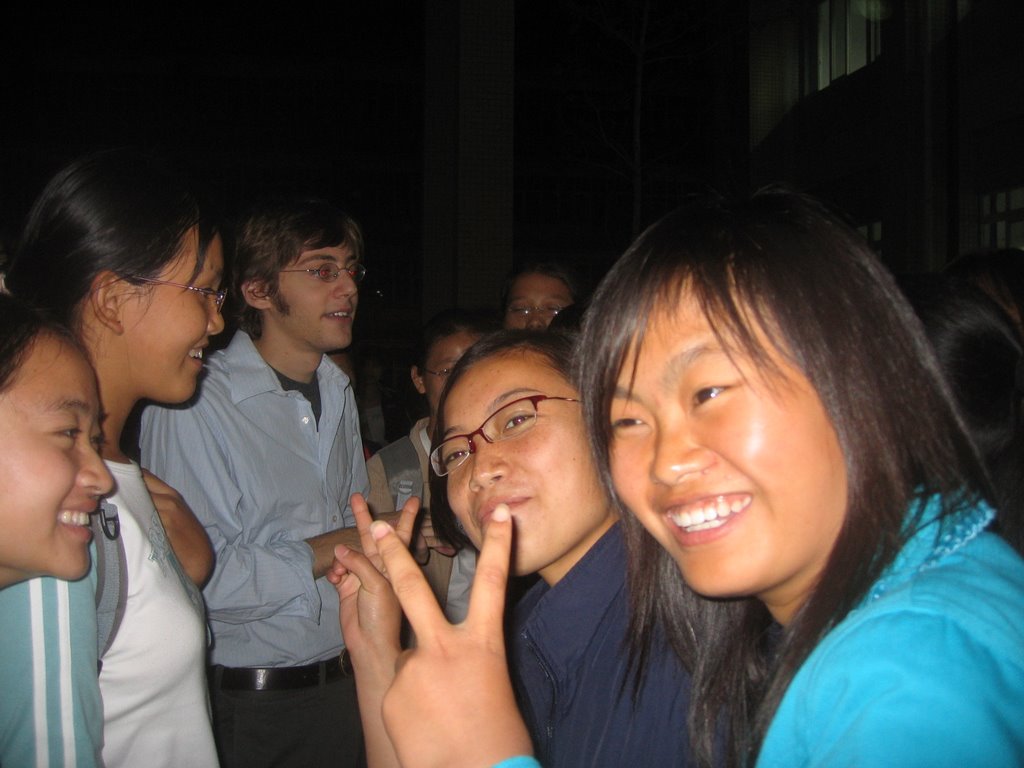
After giving the speech I was swarmed by almost all of the freshmen who had come to the English corner. About 90% of them were girls. One by one they asked me questions and I did my best to answer them as completely as possible. Unfortunately most of the questions were the typical ones I hear like, "What is your favorite Chinese food?" (Beijing kaoya), "What do you think about China?"(Wow! The people are so friendly and the food is delicious!), "Can you speak Chinese?" (yi dian dian), "Do you like Sichuan food?" (No Sichuan food is horribly revolting and too spicy to be enjoyable by anyone without a steel tongue.. No I mean I like it oops!). I managed to get a couple pictures which really made the whole experience worthwhile. When the English corner ended at 9:30, everyone wanted to take a picture with me on their camera phone. It's probably the closest to celebrity-dome that I'll ever get. Everyone wanted my phone number and e-mail. Many girls told me I was very handsome and that they were afraid to talk to me. That's probably because I just reek of unharnessed sexual intimidation, hah!

Tuesday, October 10, 2006

back to school

Today (actually last week, but I've posted this on Sunday) was the first day of classes back from the National Day vacation. I had a total of three one-and-a-half hour classes of "Advanced Oral English". I've really begun to pick up on each class' unique personality. Some classes are quiet and slow to respond to questions while others are visibly engaged and talkative. My goal now is to make the quiet classes more active. I've started writing down people's names who volunteer in class, and it's really improved the student's attention.

I did a lesson on relationships and dating in the United States. We started with dating vocabulary including, "Blind date, double date, to go steady, and to go Dutch". Then, I split the class into groups of five and read five true or false questions about dating and relationships in the United States:

1. Most Americans begin dating in Middle School or High School
2. Americans usually have many boyfriends or girlfriends
3. Americans exchange wedding bands after getting married
4. Couples in the US usually go Dutch when paying for a bill
5. The divorce rate in the United States is ____ %

My last class really had fun with the questions and I was pleased to see some really heated discussions taking place. I think the divorce rate question was the favorite because no one knew exactly what it was. Most students guessed around 60-70%. Just in case you were wondering, the US census puts it around 52-53%. We then turned the questions around and talked about what the situation was like in China. Most students agreed that in China, the divorce rate was around 10-15%. I haven't been able to verify it, but it's an interesting statistic nonetheless. In my last class of the day, I had planned on doing an activity involving describing and drawing the ideal bachelor and bachelorette, but instead we ended up having a 40 minute talk about the reasons why the rate is so much higher in the United States than it is in China. Some students volunteered really insightful arguments regarding understandings of personal freedom, traditional vs. modern ways of thinking, and even women's rights. I wished I had some taped recording of what was said. It was by far the best class I've had at CWNU.

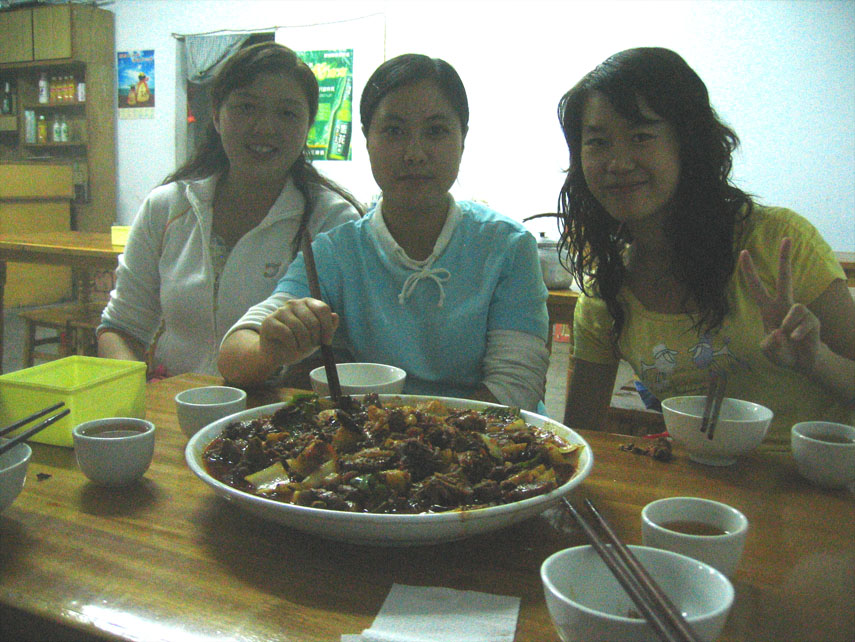
I'm also still getting the hang of hospitality here in China. I've had a lot of students ask me to get lunch or dinner or go downtown. It is customary when a boy and a girl get a meal for the boy to pay the entire bill - no questions asked. When discussing relationships in my oral English classes, students all agreed that going Dutch is completely unheard of in China while in the United States it is culturally acceptable. When I go out with students, I consistenly make an effort to pay especially when I know the bill is expensive. Sometimes I am successful, but other times I'm not. I know students have considerable less money than I do; very few of them have jobs, they tend to receive little money from their parents, and (especially at CWNU) the majority are from less developed rural villages. I feel guilty letting the students pay, but if I'm invited I know I should just shut up and let them. Despite paying for the bill, I always enjoy eating dinner with students because it's a good chance to talk about things beyond 'Where are you from?' and 'What do you think about China?' The following is a picture from a dinner I had a few days ago with some juniors of mine (left to right: Kristen, Joy, and Louise).

On Friday, I had my first lesson with my new Chinese teacher. Her English name is Sure, though I've forgotten her Chinese name already. Most Chinese names go in one ear and out the other because the words are just so foreign still. Sure is 24-years-old and teaches English and Chinese at CWNU. She's been trained in teaching Chinese to foreigners and taught the Peace Corps couple who just finished their service. I have two lessons a week for one hour at a time. The Peace Corps reimburses me for tutoring fees up to 400 kuai a month, and I've arranged to give her all 400 kuai. When she left, she went through my DVD collection and took 'School of Rock' and 'Bowling for Columbine'. It'll be interesting to see what she thought of 'Bowling'.

On a side note - yesterday, wikipedia (in English) was removed from the list of banned sites within China. Wikipedia in Chinese still remains censored and inaccessible in mainland China. This is great not only because now I can much more easily find some facts and tidbits I can use in class, but it is also a symbol of relaxing government internet and information censorship standards.

http://www.nytimes.com/2006/10/16/technology/16wikipedia.html?_r=1&ref=business&oref=slogin

Wednesday, October 04, 2006

the intro

I made this blog on October 3rd, the last official day of the national day celebrations here in China; the three day celebration marking the foundation of the People's Republic of China by Chairman Mao Zedong on October 1st, 1949.

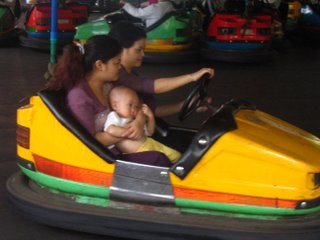
The first day I went downtown and met up with Sarah, another PCV, and we went into the city center to see what was happening. The central park was full of people, and of course we got the usual gawking, pointing, and ever-so-popular high-pitched Chinese girl giggle. Part of the park is more like a carnival than a park and includes several games and amusement rides including bumper cars and a few tame roller coasters. I love bumper cars and immediately went over to check them out. I was surprised to see many mothers with their infants, who could not have been more than a year old, in the bumper cars getting smacked around by all the other cars. Would this ever happen in the United States? I'm not sure. In any event, I took a picture and it gave me the motivation to create this blog: bumper cars with infants.

I'm a teacher at China West Normal University and a Peace Corps volunteer. I teach two classes of writing to sophomores and five classes of advanced oral English to juniors for a total of 14 teaching hours. During the week I hold office hours, help out with a university English radio show, meet up with students, watch movies, study Chinese, and grade papers. The school has about 30,000 undergraduate and postgraduate students with more majors than I could list here. Most of the students will go on to become teachers (hence the "normal" designation) after graduation.

Last Friday was the CCTV cup English speaking contest at China West. There were a total of 8 contestants, all English majors at the university. The winner goes on to Chengdu to compete against other winners from around Sichuan province for a scholarship and an internship with CCTV. Two were students from one of my sophomore writing classes. The topic was "gain and loss". All of the speeches were about some dull and superficial explanation like a loss was actually a gain in disguise or that we shouldn't feel sad when we lose or fail. After a four to five minute memorized speech, the students then had to answer one question from one of the judges which included myself, another foreign teacher, two English department administrators, and a female Chinese English teacher. The student then selected a number from one-to-nine which corresponded to a picture. Of the pictures I can remember, one was of a news story about China entering the WTO, another of an anorexic model, a Chinese space shuttle being launched, a popular Chinese soap opera, and an image from a Chinese internet chat service. The students had 30 seconds to prepare, then were able to talk for two to three minutes.

After the picture response, the rest of the judges and I wrote down a score and handed it to one of the contest hosts. I was advised that (even now I am still unsure of why) the lowest score I should give is an 8.0. Most of the scores I gave were around 8.8 to 9.0. Of the eight contestants, the top two students tied for 9.1 and went onto a playoff round. One of the two finalists (the girl in the picture) whose name is Joy, is in my writing class. I was asked by one of the hosts to propose a question to each of the contestants, and I said something to the effect of, "Is there such a thing as a loss with no gain, for example losing a family member?" In retrospect it was as superficial as most of the speeches, but how many questions can you really ask about gain and loss? The Chinese English teacher also asked a question before the judges panel wrote down their choice as the winner. I thought Joy had done a much better job, despite the fact that I had something vested in the result (I was the winner's teacher! haha), but the other student won 3-2. Afterwards I presented some awards to the runner-ups and took pictures. It was a fun initiation to these contests which apparently happen several times a year.